

solution stringlengths 2 12.9k | answer stringlengths 1 253 | question stringlengths 2 6.18k | math_type stringclasses 9
values | source_type stringclasses 34
values | metadata stringclasses 284
values | domain stringclasses 55
values | difficulty float64 1 10 |
|---|---|---|---|---|---|---|---|
B4. 16 Name the points and areas as in the figure. The area of triangle $A D F$ is equal to $a+b+e$ and also to half the area of rectangle $A B C D$. The area of triangle $C D E$ is equal to $b+c+d$ and also to half the area of rectangle $A B C D$. If we add these two areas, we get the area of the entire rectangle. The... | 16 | B4. A rectangle is divided into eight pieces by four line segments as shown in the figure. The areas of three pieces are given, namely 3, 5, and 8.
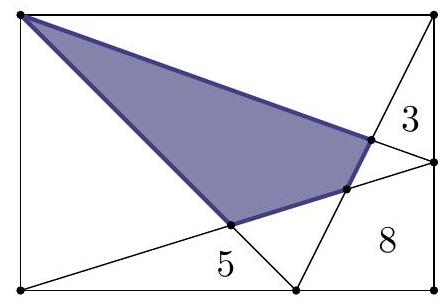
What is the area of the shaded quadrilater... | Geometry | AI-MO/NuminaMath-1.5/olympiads | {'question_type': 'math-word-problem', 'problem_is_valid': 'Yes', 'solution_is_valid': 'Yes', 'synthetic': False} | null | 4.5 |
Solution. $D=4-4 a$.
$\left(x_{1}-x_{2}\right)^{2}=\left(x_{1}+x_{2}\right)^{2}-4 x_{1} x_{2}=\left(\frac{2}{a}\right)^{2}-4 \cdot \frac{1}{a}=\frac{4-4 a}{a^{2}}=\frac{D}{a^{2}}$.
We obtain the equation: $\frac{D}{a^{2}} \cdot 9=D$. The condition $D>0$ is satisfied only by the root $a=-3$.
Answer: $a \in\{-3\}$. | \in{-3} | # Task 2.
Find the set of values of the parameter $a$ for which the discriminant of the equation $a x^{2}+2 x+1=0$ is 9 times the square of the difference of its two distinct roots. | Algebra | AI-MO/NuminaMath-1.5/olympiads | {'question_type': 'math-word-problem', 'problem_is_valid': 'Yes', 'solution_is_valid': 'Yes', 'synthetic': False} | General algebraic systems | 2.333333 |
3 C. The 1991st positive odd number is
$$
\begin{array}{c}
2 \times 1991-1=3981 \\
3969=63^{2}<3981<65^{2}=4225 \\
3981+2 \times \frac{63+1}{2}=4045
\end{array}
$$ | 4045 | 3 After removing all the perfect squares from the sequence of positive odd numbers, the 1991st number is
A. 4013
B. 4007
C. 4045
D. 4225 | Number Theory | AI-MO/NuminaMath-1.5/olympiads | {'question_type': 'MCQ', 'problem_is_valid': 'Yes', 'solution_is_valid': 'Yes', 'synthetic': False} | Sequences, series, summability | 3 |
First, we will determine how many gingerbread cookies they decorated in total. There were 5 trays of twelve cookies each, which makes 60 cookies $(5 \cdot 12=60)$.
If all three of them took a cookie at the same time and started decorating it, then under the given conditions, all three would take another cookie at the ... | 4,140,40 | Jeníček and Mařenka visit their grandmother, who has a confectionery and sells gingerbread. Both of them naturally help her, especially with decorating. In the time it takes for the grandmother to decorate five gingerbreads, Mařenka decorates three and Jeníček decorates two. During their last visit, all three of them d... | Logic and Puzzles | AI-MO/NuminaMath-1.5/olympiads | {'question_type': 'math-word-problem', 'problem_is_valid': 'Yes', 'solution_is_valid': 'Yes', 'synthetic': False} | General algebraic systems | 2.5 |
Lemma. Among any five nodes of a grid of equilateral triangles, there will be two such that the midpoint of the segment between them is also a grid node.
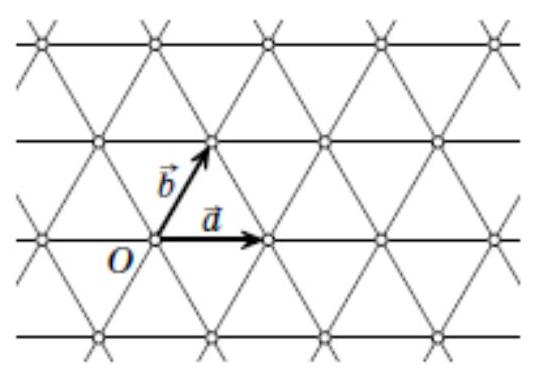
Proof of the lemma. Introduce the o... | 9 | Kuuyggin A.K.
Among any five nodes of a regular square grid, there will always be two nodes such that the midpoint of the segment between them is also a node of the grid. What is the minimum number of nodes of a regular hexagonal grid that must be taken so that among them there will always be two nodes such that the m... | Combinatorics | AI-MO/NuminaMath-1.5/olympiads | {'question_type': 'math-word-problem', 'problem_is_valid': 'Yes', 'solution_is_valid': 'Yes', 'synthetic': False} | null | 9.5 |
The median line of a triangle cuts off a similar triangle from it, with a similarity coefficient of $\frac{1}{2}$. Therefore, the area of the cut-off triangle is one-fourth of the area of the original triangle, i.e., $\frac{1}{\mathbf{4}} 16=4$. Consequently, the area of the remaining trapezoid is $16-4=12$.
## Answer... | 12 | The area of the triangle is 16. Find the area of the trapezoid that is cut off from the triangle by its midline.
# | Geometry | AI-MO/NuminaMath-1.5/olympiads | {'question_type': 'math-word-problem', 'problem_is_valid': 'Yes', 'solution_is_valid': 'Yes', 'synthetic': False} | Geometry | 1.666667 |
}
For this task, it is assumed that 0 is a natural number.
Then for each natural \(x \leq 199\), there are exactly \(1993-10 x\) different possibilities for \(y\) to choose (namely 0 to \(1993-10 x-1\)), such that the inequality is satisfied. Summing this over all \(x\), we thus obtain
\(\sum_{x=0}^{199}(1993-10 x)=... | 199600 | \section*{Problem 2 - 320932}
How many pairs \((x, y)\) of natural numbers for which \(10 x+y<1993\) exist in total? | Number Theory | AI-MO/NuminaMath-1.5/olympiads | {'question_type': 'math-word-problem', 'problem_is_valid': 'Yes', 'solution_is_valid': 'Yes', 'synthetic': False} | Combinatorics | 1.333333 |
Solution. We will show that the sought number is 5.
Let $A B C D A^{\prime} B^{\prime} C^{\prime} D^{\prime}$ be a cube. By coloring the 4 vertices of one face of the cube in red, for example $A, B, C, D$, there is no vertex that has all three adjacent vertices red, so $n \geq 5$.
Now, for $n=5$, no matter how we col... | 5 | Problem 2. Determine the smallest natural number $n$ such that, no matter which $n$ vertices of a cube we color red, there exists a vertex of the cube that has all three adjacent vertices red. | Combinatorics | AI-MO/NuminaMath-1.5/olympiads | {'question_type': 'math-word-problem', 'problem_is_valid': 'Yes', 'solution_is_valid': 'Yes', 'synthetic': False} | Combinatorics | 3 |
Consider similar triangles.
## Solution
Let $P$ be the projection of vertex $C$ onto line $AK$. From the similarity of triangles $KRC$ and $KDA$, it follows that $CP: CK = AD: AK$. Therefore,
$CP = \frac{CK \cdot AD}{AK} = \frac{\frac{1}{3}}{\sqrt{1 + \left(\frac{2}{3}\right)^2}} = \frac{1}{\sqrt{13}}$.
. Vasya lives in the fourth entrance. It is known that for Pete to run to Vasya by the shortest path (not necessarily along the sides of the cells), it does not matter which side he runs around his house. Determine which entrance Pete lives in.
## [5 point... | Logic and Puzzles | AI-MO/NuminaMath-1.5/olympiads | {'question_type': 'math-word-problem', 'problem_is_valid': 'Yes', 'solution_is_valid': 'Yes', 'synthetic': False} | Geometry | 4 |
【Answer】Solution: According to the problem, transporting four times, going four times and returning three times, eats up $5 \times(4+3)=35$ sticks, then the maximum number of sticks that can be transported to location $B$ is $200-35=165$, so the answer is: D. | 165 | 10. (10 points) A giant panda is transporting bamboo from location $A$ to location $B$. Each time, he can carry 50 bamboo sticks, but he eats 5 sticks both when walking from $A$ to $B$ and when returning from $B$ to $A$. There are currently 200 bamboo sticks at location $A$. How many bamboo sticks can the giant panda t... | Logic and Puzzles | AI-MO/NuminaMath-1.5/olympiads | {'question_type': 'MCQ', 'problem_is_valid': 'Yes', 'solution_is_valid': 'Yes', 'synthetic': False} | Mathematical logic and foundations | 1 |
$\triangle A B C$ is a right angled isosceles triangle.
$$
\begin{array}{l}
\angle B A C=45^{\circ}(\angle \mathrm{s} \text { sum of } \triangle \text {, base } \angle \mathrm{s} \text { isos. } \triangle \text { ) } \\
\left.\angle A C D=45^{\circ} \text { (alt. } \angle \mathrm{s}, A B / / D C\right) \\
\angle B C D=... | 15 | SG. 2 In figure $1, A B$ is parallel to $D C, \angle A C B$ is a right angle, $A C=C B$ and $A B=B D$. If $\angle C B D=b^{\circ}$, find the value of $b$. | Geometry | AI-MO/NuminaMath-1.5/olympiads | {'question_type': 'math-word-problem', 'problem_is_valid': 'Yes', 'solution_is_valid': 'Yes', 'synthetic': False} | Geometry | 2.4 |
$D N$ and $E M$ are the altitudes of triangle $C D E$, which means that triangles $C M N$ and $C E D$ are similar with a coefficient of $\cos \angle C$.
Therefore, $M N=D E \cos \angle C=\frac{c}{2} \cdot \frac{a^{2}+b^{2}-c^{2}}{2 a b}$.
## Answer
$\frac{c\left(a^{2}+b^{2}-c^{2}\right)}{4 a b}$ | \frac{(^{2}+b^{2}-^{2})}{4} | In triangle $A B C$, on the midline $D E$, parallel to $A B$, a circle is constructed with $D E$ as its diameter, intersecting sides $A C$ and $B C$ at points $M$ and $N$.
Find $M N$, if $B C=a, A C=b, A B=c$. | Geometry | AI-MO/NuminaMath-1.5/olympiads | {'question_type': 'math-word-problem', 'problem_is_valid': 'Yes', 'solution_is_valid': 'Yes', 'synthetic': False} | null | 4 |
7. E.
Notice,
$$
400\left(\frac{2}{5}\right)^{n}=2^{5} \times 5^{3}\left(\frac{2}{5}\right)^{n}=2^{n+5} \times 5^{3-n} \text {, }
$$
where, $n+5$ and $3-n$ are both non-negative integers. Therefore, $n=-5,-4, \cdots, 3$, a total of 9. | 9 | 7. There are $(\quad)$ integers $n$, such that $400\left(\frac{2}{5}\right)^{n}$ is an integer.
(A) 3
(B) 4
(C) 6
(D) 8
(E) 9 | Number Theory | AI-MO/NuminaMath-1.5/olympiads | {'question_type': 'MCQ', 'problem_is_valid': 'Yes', 'solution_is_valid': 'Yes', 'synthetic': False} | null | 7 |
Answer: 0 m/s or $0.8 \mathrm{~m} / \mathrm{s}$.
Solution. The mosquito flew a distance of $s=v t=0.5 \cdot 20=10$ m before landing.
That is, it moved along the trajectory $A B$.
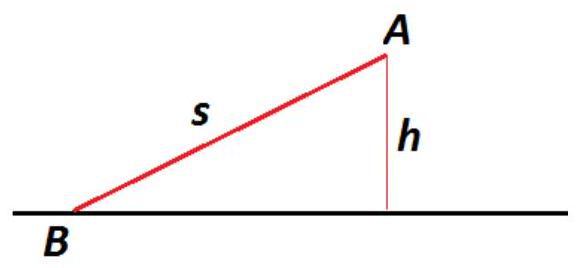
The cosi... | 0 | 8. (15 points) A mosquito was moving over the water in a straight line at a constant speed of \( v = 0.5 \) m/s and at the end of its movement, it landed on the water surface. 20 seconds before landing, it was at a height of \( h = 6 \) m above the water surface. The cosine of the angle of incidence of the sunlight on ... | Other | AI-MO/NuminaMath-1.5/olympiads | {'question_type': 'math-word-problem', 'problem_is_valid': 'Yes', 'solution_is_valid': 'Yes', 'synthetic': False} | Mechanics of particles and systems | 3 |
Solution 1. Let $a-b=t$. Due to $a^{3}-b^{3} \geq 11 a b$ we conclude that $a>b$ so $t$ is a positive integer and the condition can be written as
$$
11 b(b+t) \leq t\left[b^{2}+b(b+t)+(b+t)^{2}\right] \leq 12 b(b+t)
$$
Since
$$
t\left[b^{2}+b(b+t)+(b+t)^{2}\right]=t\left(b^{2}+b^{2}+b t+b^{2}+2 b t+t^{2}\right)=3 t... | (5,2) |
Problem 1. Find all pairs $(a, b)$ of positive integers such that
$$
11 a b \leq a^{3}-b^{3} \leq 12 a b
$$
| Inequalities | AI-MO/NuminaMath-1.5/olympiads | {'question_type': 'math-word-problem', 'problem_is_valid': 'Yes', 'solution_is_valid': 'Yes', 'synthetic': False} | Number theory | 3.2 |
Answer: 1.
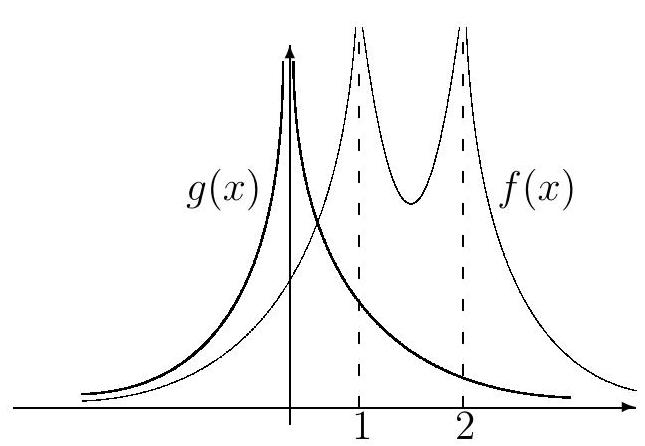
Solution. Let's introduce the functions $f(x)=\frac{1}{(x-1)^{2}}+\frac{1}{(x-2)^{2}}$ and $g(x)=\frac{2}{x^{2}}$.
For $x<0$, both functions $f$ and $g$ are positive, but $f(x)$ increases from $+\infty$ to 2 (not inclusive), since $f^{\prime}(x)=\frac{-2}{(x-1)^{3}}-\frac{2}{(x-2)^{3}}<0 \quad \text { for ... | 1 | 7. How many solutions does the equation
\[
\frac{1}{(x-1)^{2}}+\frac{1}{(x-2)^{2}}=\frac{2}{x^{2}} ?
\]
 | Algebra | AI-MO/NuminaMath-1.5/olympiads | {'question_type': 'math-word-problem', 'problem_is_valid': 'Yes', 'solution_is_valid': 'Yes', 'synthetic': False} | Ordinary differential equations | 1.666667 |
60. Answer: $600=25 \cdot 24$ candies.
Let's show that a smaller number of candies might not be enough. If all participants solved the same number of problems, the number of candies must be a multiple of 25. Let $N=25 k$. Imagine that 24 people solved the same number of problems, while the 25th solved fewer. If each o... | 600 | 60. In a class, there are 25 students. The teacher wants to stock $N$ candies, conduct an olympiad, and distribute all $N$ candies for success in it (students who solve the same number of problems should receive the same number of candies, those who solve fewer should receive fewer, including possibly zero candies). Wh... | Number Theory | AI-MO/NuminaMath-1.5/olympiads | {'question_type': 'math-word-problem', 'problem_is_valid': 'Yes', 'solution_is_valid': 'Yes', 'synthetic': False} | Combinatorics | 5.6 |
[Solution]The last digit of a perfect square can only be $1,4,5,6,9,0$.
This allows us to eliminate $(B),(C)$.
Furthermore, for a perfect square ending in 5, the last two digits should be 25.
By examining the last two digits of the squares in groups $(A),(D)$, we find that $(A)$ is the correct choice. Therefore, the an... | A | $33 \cdot 17$ Given that among the following four sets of values for $x$ and $y$, there is exactly one set for which $\sqrt{x^{2}+y^{2}}$ is an integer. This set of $x$ and $y$ values is
(A) $x=88209, y=90288$.
(B) $x=82098, y=89028$.
(C) $x=28098, y=89082$.
(D) $x=90882, y=28809$.
(Chinese Jiangsu Province Junior High... | Number Theory | AI-MO/NuminaMath-1.5/olympiads | {'question_type': 'MCQ', 'problem_is_valid': 'Yes', 'solution_is_valid': 'Yes', 'synthetic': False} | Number theory | 4.25 |
$$
-20^{\circ}
$$
7. [Analysis and Solution] According to the problem, we have $2000^{\circ}=180^{\circ} \times 11+20^{\circ}$,
$$
\begin{array}{l}
\therefore \sin 2000^{\circ}=\sin \left(180^{\circ} \times 11+20^{\circ}\right)=\sin \left(-20^{\circ}\right), \\
\therefore \arcsin \left(2000^{\circ}\right)=-20^{\circ}
\... | -20 | 7. $\arcsin \left(\sin 2000^{\circ}\right)=$
Translate the above text into English, please retain the original text's line breaks and format, and output the translation result directly.
7. $\arcsin \left(\sin 2000^{\circ}\right)=$ | Algebra | AI-MO/NuminaMath-1.5/olympiads | {'question_type': 'math-word-problem', 'problem_is_valid': 'Yes', 'solution_is_valid': 'Yes', 'synthetic': False} | Functions of a complex variable | 1 |
Yihana is walking uphill exactly when the graph is increasing (that is, when the slope of the segment of the graph is positive).
This is between 0 and 3 minutes and between 8 and 10 minutes, which correspond to lengths of time of 3 minutes and 2 minutes in these two cases, for a total of 5 minutes.
ANSWER: (A)
# | 5 | Yihana walks for 10 minutes. A graph of her elevation in metres versus time in minutes is shown. The length of time for which she was walking uphill is
(A) 5 minutes
(B) 6 minutes
(C) 4 minutes
(D) 7 minutes
(E) 8 minutes
\}$;
When $t=-2$, the set
$$
A=\left\{(x, y) \mid(x+2)^{2}+y^{2} \leqslant 4\right\} \text {. }
$$
Thus, the required region is the closed area formed by drawing two tangents from the point $(2,0)$ to the circle $(x+2)^{2}+$ $y^{2}=4$ (as shown in Figure ... | 4\sqrt{3}+\frac{8\pi}{3} | 5. The set
$$
A=\left\{\left.(x, y)\left|(x-t)^{2}+y^{2} \leqslant\left(1-\frac{t}{2}\right)^{2},\right| t \right\rvert\, \leqslant 2\right\}
$$
represents a plane region with an area of $\qquad$ . | Geometry | AI-MO/NuminaMath-1.5/olympiads | {'question_type': 'math-word-problem', 'problem_is_valid': 'Yes', 'solution_is_valid': 'Yes', 'synthetic': False} | Geometry | 5 |
Answer: 12.
## Solution:
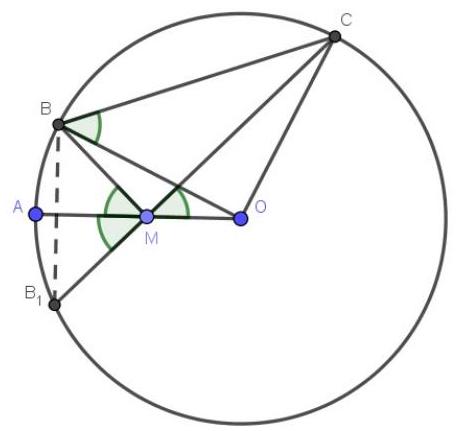
Consider point $B_{1}$, which is symmetric to point $B$ with respect to the line $O A$. It also lies on the circle and $\angle A M B=\alpha$. Note that points $B_{... | 12 | 3. (7 points) On the radius $A O$ of a circle with center $O$, a point $M$ is chosen. On one side of $A O$ on the circle, points $B$ and $C$ are chosen such that $\angle A M B = \angle O M C = \alpha$. Find the length of $B C$ if the radius of the circle is $15$, and $\sin \alpha = \frac{\sqrt{21}}{5}$? | Geometry | AI-MO/NuminaMath-1.5/olympiads | {'question_type': 'math-word-problem', 'problem_is_valid': 'Yes', 'solution_is_valid': 'Yes', 'synthetic': False} | Geometry | 3 |
7. $\frac{18}{5}$.
First, prove that the height $D H$ of tetrahedron $A B C D$ is the diameter of the small sphere.
Draw $H E \perp A B$ at point $E$, and $H F \perp A C$ at point $F$. Then
$$
\begin{array}{l}
A E=A F=A D \cos \angle D A B=\frac{3}{\sqrt{2}}, \\
\cos \angle H A E=\sqrt{\frac{1+\cos \angle B A C}{2}}=... | \frac{18}{5} | 7. A sphere is circumscribed around the tetrahedron $ABCD$, and another sphere with radius 1 is tangent to the plane $ABC$ and the two spheres are internally tangent at point $D$. If
$$
\begin{array}{l}
AD=3, \cos \angle BAC=\frac{4}{5}, \\
\cos \angle BAD=\cos \angle CAD=\frac{1}{\sqrt{2}},
\end{array}
$$
then the vo... | Geometry | AI-MO/NuminaMath-1.5/olympiads | {'question_type': 'math-word-problem', 'problem_is_valid': 'Yes', 'solution_is_valid': 'Yes', 'synthetic': False} | null | 7 |
The required minimum is 6 m and is achieved by a diagonal string of $m 4 \times 4$ blocks of the form below (bullets mark centres of blue cells):
In particular, this configuration shows that the required minimum does not exceed 6 m.
We now show that any configuration of blue cells satisfying the condition in the stat... | 6m | Let $m$ be a positive integer. Consider a $4 m \times 4 m$ array of square unit cells. Two different cells are related to each other if they are in either the same row or in the same column. No cell is related to itself. Some cells are coloured blue, such that every cell is related to at least two blue cells. Determine... | Combinatorics | AI-MO/NuminaMath-1.5/olympiads_ref | {'question_type': 'math-word-problem', 'problem_is_valid': 'Yes', 'solution_is_valid': 'Yes', 'synthetic': False} | Combinatorics | 6.4 |
25. Ans: 13
Let $O$ be the centre of the circle. First we show that $P, B, O, M, E$ lie on a common circle. Clearly $P, B, O, E$ are concyclic. As $\angle B P M=\angle H B C=\angle B E M=30^{\circ}$, points $P, B, M, E$ are also concyclic. Thus $P, B, O, M, E$ all lie on the circumcircle of $\triangle P B E$.
Since $\... | 13 | 25. A pentagon $A B C D E$ is inscribed in a circle of radius 10 such that $B C$ is parallel to $A D$ and $A D$ intersects $C E$ at $M$. The tangents to this circle at $B$ and $E$ meet the extension of $D A$ at a common point $P$. Suppose $P B=P E=24$ and $\angle B P D=30^{\circ}$. Find $B M$. | Geometry | AI-MO/NuminaMath-1.5/olympiads | {'question_type': 'math-word-problem', 'problem_is_valid': 'Yes', 'solution_is_valid': 'Yes', 'synthetic': False} | null | 7.2 |
# Answer: 664.
Solution. Consider the remainders of the numbers when divided by 3. Divisibility by 3 means that in each pair of numbers standing one apart, either both numbers are divisible by 3, or one has a remainder of 1 and the other has a remainder of 2 when divided by 3. Among the numbers from 1 to 1000, 333 are... | 664 | 9.4. $N$ different natural numbers, not exceeding 1000, are written in a circle such that the sum of any two of them, standing one apart, is divisible by 3. Find the maximum possible value of $N$.
# | Number Theory | AI-MO/NuminaMath-1.5/olympiads | {'question_type': 'math-word-problem', 'problem_is_valid': 'Yes', 'solution_is_valid': 'Yes', 'synthetic': False} | null | 6 |
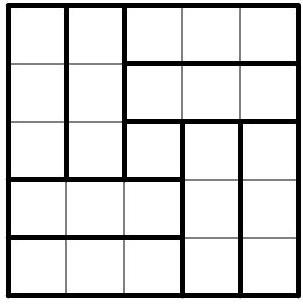
Rectangle $A B C D$ is divided into five congruent rectangles as shown. The ratio $A B: B C$ is
(A) $3: 2$
(B) 2:1
(C) $5: 2$
(D) $5: 3$
(E) $4: 3$

## Solution
If we let the width of each... | 5:3 | Rectangle $A B C D$ is divided into five congruent rectangles as shown. The ratio $A B: B C$ is
(A) 3:2
(D) $5: 3$
(B) $2: 1$
(E) $4: 3$
(C) $5: 2$ | Geometry | AI-MO/NuminaMath-1.5/olympiads | {'question_type': 'MCQ', 'problem_is_valid': 'Yes', 'solution_is_valid': 'Yes', 'synthetic': False} | null | 2.4 |
To solve for $a$, $b$, and $c$ to form the sides of a triangle, it is clear that they cannot be 0, i.e., $a, b, c \in \{1, 2, \cdots, 9\}$.
(1) If they form an equilateral triangle, let the number of such three-digit numbers be $n_{1}$. Since all three digits in the three-digit number are the same, we have:
$$
n_{1} =... | 165 | (5) Let the three-digit number $n=\overline{a b c}$, if the lengths of the sides of a triangle can be formed by $a, b, c$ to constitute an isosceles (including equilateral) triangle, then the number of such three-digit numbers $n$ is ( ).
(A) 45
(B) 81
(C) 165
(D) 216 | Number Theory | AI-MO/NuminaMath-1.5/olympiads | {'question_type': 'MCQ', 'problem_is_valid': 'Yes', 'solution_is_valid': 'Yes', 'synthetic': False} | Combinatorics | 5 |
The pattern is quite simple to see after listing a couple of terms.
\[\begin{tabular}{|r|r|r|} \hline \#&\text{Removed}&\text{Left}\\ \hline 1&10&90\\ 2&9&81\\ 3&9&72\\ 4&8&64\\ 5&8&56\\ 6&7&49\\ 7&7&42\\ 8&6&36\\ 9&6&30\\ 10&5&25\\ 11&5&20\\ 12&4&16\\ 13&4&12\\ 14&3&9\\ 15&3&6\\ 16&2&4\\ 17&2&2\\ 18&1&1\\ \hline \... | 18 | A set of tiles numbered 1 through 100 is modified repeatedly by the following operation: remove all tiles numbered with a [perfect square](https://artofproblemsolving.com/wiki/index.php/Perfect_square), and renumber the remaining tiles consecutively starting with 1. How many times must the operation be performed to red... | Number Theory | AI-MO/NuminaMath-1.5/amc_aime | {'question_type': 'MCQ', 'problem_is_valid': 'Yes', 'solution_is_valid': 'Yes', 'synthetic': False} | Number theory | 3 |
$$
2 b=a+c \ldots \ldots
$$
(1), $3 a=b+c$
(1) - (2): $2 b-3 a=a-b \Rightarrow 3 b=4 a \Rightarrow a: b=3: 4$
Let $a=3 k, b=4 k$, sub. into (1): $2(4 k)=3 k+c \Rightarrow c=5 k$
$$
Q=\frac{a+b+c}{a}=\frac{3 k+4 k+5 k}{3 k}=4
$$ | 4 | I2.2 Let $a, b$ and $c$ be real numbers with ratios $b:(a+c)=1: 2$ and $a:(b+c)=1: P$.
If $Q=\frac{a+b+c}{a}$, find the value of $Q$. | Algebra | AI-MO/NuminaMath-1.5/olympiads | {'question_type': 'math-word-problem', 'problem_is_valid': 'Yes', 'solution_is_valid': 'Yes', 'synthetic': False} | General algebraic systems | 3.2 |
6. $\frac{3+2 \sqrt{2}}{5}$.
$$
\begin{array}{l}
\text { Given } 1=\frac{1}{x+3 y}+\frac{1}{2 x+y}=\frac{1}{x+3 y}+\frac{2}{4 x+2 y} \\
\geqslant \frac{(1+\sqrt{2})^{2}}{5(x+y)} \\
\Rightarrow x+y \geqslant \frac{(1+\sqrt{2})^{2}}{5}=\frac{3+2 \sqrt{2}}{5} .
\end{array}
$$
When $x=\frac{4+\sqrt{2}}{10}, y=\frac{2+3 \s... | \frac{3+2\sqrt{2}}{5} | 6. Given positive real numbers $x, y$ satisfy
$$
\frac{1}{x+3 y}+\frac{1}{2 x+y}=1 \text {. }
$$
Then the minimum value of $x+y$ is | Algebra | AI-MO/NuminaMath-1.5/olympiads | {'question_type': 'math-word-problem', 'problem_is_valid': 'Yes', 'solution_is_valid': 'Yes', 'synthetic': False} | null | 5 |
For each knob, the 8 different positions are denoted as $1,2, \cdots, 8$, and each combination is denoted as $(i, j, k)$, where $1 \leqslant i, j, k \leqslant 8$. Below, using the dictionary order, we write down 16 triples $(i, j, k)$ for $1 \leqslant i, j, k \leqslant 4$ such that any two triples have at most one numb... | 32 | 7.109 Given that the lock on a safe is composed of 3 dials, each with 8 different positions. Due to disrepair, the safe can now be opened as long as two out of the three dials are in the correct position. How many combinations must be tried at a minimum to ensure the safe can be opened? | Combinatorics | AI-MO/NuminaMath-1.5/olympiads | {'question_type': 'math-word-problem', 'problem_is_valid': 'Yes', 'solution_is_valid': 'Yes', 'synthetic': False} | Combinatorics | 5 |
[Solution]By Vieta's formulas, we get $a^{2}+b^{2}=c, a^{2} b^{2}=c$, hence $\quad a^{2}+b^{2}=a^{2} b^{2}, \quad \therefore \quad b^{2}-1=\frac{b^{2}}{a^{2}}, \quad a^{2}-1=\frac{a^{2}}{b^{2}}$. If $a>0, b>0$, then
$$
\begin{aligned}
& a \sqrt{1-\frac{1}{b^{2}}}+b \sqrt{1-\frac{1}{a^{2}}} \\
= & \sqrt{a^{2}-\frac{a^{2... | D | 2.71 $a, b$ are two non-zero real numbers, $a^{2}, b^{2}$ are the roots of the equation $x^{2}-c x+c=0$, then the value of the algebraic expression $a \sqrt{1-\frac{1}{b^{2}}}+b \sqrt{1-\frac{1}{a^{2}}}$ is
(A) 0.
(B) 2.
(C) Does not exist.
(D) None of the above answers is correct.
(China Jiangxi Province Nanchang City... | Algebra | AI-MO/NuminaMath-1.5/olympiads | {'question_type': 'MCQ', 'problem_is_valid': 'Yes', 'solution_is_valid': 'Yes', 'synthetic': False} | General algebraic systems | 2.5 |
8. 8 .
Let point $P\left(2 t^{2}, 2 t\right)$.
Since it is an incircle, we know $|t|>1$.
Let the slope of the line passing through point $P$ be $k$. Then the equation of the line is
$$
y-2 t=k\left(x-2 t^{2}\right) \text {. }
$$
Since this line is tangent to the circle, we have
$$
d=\frac{\left|2 t^{2} k-2 t-k\right|... | 8 | 8. Given that $P$ is a moving point on the parabola $y^{2}=2 x$, points $B$ and $C$ are on the $y$-axis, and $(x-1)^{2}+y^{2}=1$ is the incircle of $\triangle P B C$. Then the minimum value of $S_{\triangle P B C}$ is $\qquad$ | Geometry | AI-MO/NuminaMath-1.5/olympiads | {'question_type': 'math-word-problem', 'problem_is_valid': 'Yes', 'solution_is_valid': 'Yes', 'synthetic': False} | Geometry | 8 |
【Answer】Solution: 5 can only be in the first or last position, $52314, 54132, 41325, 23145$, so the answer is: $B$. | 4 | 14. (12 points) Arrange the natural numbers from 1 to 5 in a row from left to right, such that starting from the third number, each number is the sum or difference of the previous two numbers. How many ways are there to arrange them?
A. 2
B. 4
C. 6
D. 8 | Combinatorics | AI-MO/NuminaMath-1.5/olympiads | {'question_type': 'MCQ', 'problem_is_valid': 'Yes', 'solution_is_valid': 'Yes', 'synthetic': False} | Combinatorics | 2 |
Let $x_{n+1}=x_{1}$ so that the system can be written in the form $x_{i}^{2}+x_{i+1}^{2}+$ $50=16 x_{i}+x_{i+1}$ for all $i \in\{1, \ldots, n\}$. This latter equation is equivalent to the equality $\left(x_{i}-8\right)^{2}+$ $\left(x_{i+1}-6\right)^{2}=50$, which is much more manageable for this exercise, since by exam... | n | . Find all integers $n \geqslant 2$ for which the system:
$$
\left\{\begin{aligned}
x_{1}^{2}+x_{2}^{2}+50 & =16 x_{1}+12 x_{2} \\
x_{2}^{2}+x_{3}^{2}+50 & =16 x_{2}+12 x_{3} \\
& \vdots \\
x_{n-1}^{2}+x_{n}^{2}+50 & =16 x_{n-1}+12 x_{n} \\
x_{n}^{2}+x_{1}^{2}+50 & =16 x_{n}+12 x_{1}
\end{aligned}\right.
$$
admits at... | Algebra | AI-MO/NuminaMath-1.5/olympiads | {'question_type': 'math-word-problem', 'problem_is_valid': 'Yes', 'solution_is_valid': 'Yes', 'synthetic': False} | Number theory | 4 |
Let's solve the problem more generally for $n$ teams, where $n$ is an odd number. We will represent each team with a point. After a match between two teams, an arrow should point from the losing team to the winning team. (In this context, we can assume that there has never been a tie.)
If the teams $A$, $B$, and $C$ h... | 506 | In a round-robin tournament, 23 teams participated. Each team played exactly once against all the others. We say that 3 teams have cycled victories if, considering only their games against each other, each of them won exactly once. What is the maximum number of cycled victories that could have occurred during the tourn... | Combinatorics | AI-MO/NuminaMath-1.5/olympiads | {'question_type': 'math-word-problem', 'problem_is_valid': 'Yes', 'solution_is_valid': 'Yes', 'synthetic': False} | Combinatorics | 5 |
3. The answer is $\mathbf{( B )}$.
It is necessary to calculate the radius of the inscribed circle and the radius of the circumscribed circle of the hexagon. The radius $R$ of the circumscribed circle is equal to the side of the hexagon, which measures $2 \mathrm{~m}$. The radius $r$ of the inscribed circle is given b... | \pi\mathrm{~}^{2} | 3) A regular hexagon with side length $2 \mathrm{~m}$ is given. Calculate the area of the circular ring delimited by the inscribed circle and the circumscribed circle of the hexagon.
(A) $\frac{\pi}{2} \mathrm{~m}^{2}$
(B) $\pi \mathrm{~m}^{2}$
(C) $\frac{4 \pi}{3} \mathrm{~m}^{2}$
(D) $2 \pi \mathrm{~m}^{2}$
(E) $\fra... | Geometry | AI-MO/NuminaMath-1.5/olympiads | {'question_type': 'MCQ', 'problem_is_valid': 'Yes', 'solution_is_valid': 'Yes', 'synthetic': False} | Geometry | 2 |
6. C.
Connect $M C, M N$, and draw $M E \perp A C$ at point $E$.
$$
\begin{array}{l}
\text { Then } \angle A M E=\frac{1}{2} \angle A M C=\angle A B D=60^{\circ} \\
\Rightarrow \frac{A M}{A C}=\frac{A M}{2 A E}=\frac{1}{\sqrt{3}} .
\end{array}
$$
Notice that,
$$
\begin{array}{l}
\triangle A M N \cong \triangle B M N,... | \frac{2}{3} | 6. As shown in Figure $3, \odot M$ and
$\odot N$ intersect at points $A$ and $B$, a line $CD$ through point $B$ intersects $\odot M$ and $\odot N$ at points $C$ and $D$ respectively, and $\angle ABD = 60^{\circ}$. Then the ratio of the area of quadrilateral $AMBN$ to the area of $\triangle ACD$ is ( ).
(A) $1: 2$
(B) ... | Geometry | AI-MO/NuminaMath-1.5/olympiads | {'question_type': 'MCQ', 'problem_is_valid': 'Yes', 'solution_is_valid': 'Yes', 'synthetic': False} | Geometry | 5.5 |
## Solution
$$
\begin{aligned}
& \int_{0}^{\pi} 2^{4} \sin ^{8} x d x=\int_{0}^{\pi} 2^{4}\left(\sin ^{2} x\right)^{4} d x=\int_{0}^{\pi} 2^{4}\left(\frac{1-\cos 2 x}{2}\right)^{4} d x=\int_{0}^{\pi}(1-\cos 2 x)^{4} d x= \\
& =\int_{0}^{\pi}\left(1-4 \cos 2 x+6 \cos ^{2} 2 x-4 \cos ^{3} 2 x+\cos ^{4} 2 x\right) d x= \... | \frac{35\pi}{8} | ## Problem Statement
Calculate the definite integral:
$$
\int_{0}^{\pi} 2^{4} \cdot \sin ^{8} x d x
$$ | Calculus | AI-MO/NuminaMath-1.5/olympiads | {'question_type': 'math-word-problem', 'problem_is_valid': 'Yes', 'solution_is_valid': 'Yes', 'synthetic': False} | Real functions | 4 |
# Solution.
Let $f(x)=k=x-\frac{2}{x}, f(f(x))=f(k)=k-\frac{2}{k}, f(f(f(x)))=f(f(k))=f(k)-\frac{2}{f(k)}$. The equation $f(f(f(x)))=f(k)-\frac{2}{f(k)}=1 \Leftrightarrow f^{2}(k)-f(k)-2=0$ has two solutions $f_{1}(k)=-1$ and $f_{2}(k)=2$.
We obtain $\left[\begin{array}{l}f(k)=k-\frac{2}{k}=-1 \\ f(k)=k-\frac{2}{k}=2... | 8 | # Task 11.3. (12 points)
How many distinct roots does the equation $f(f(f(x)))=1$ have, if $f(x)=x-\frac{2}{x}$. | Algebra | AI-MO/NuminaMath-1.5/olympiads | {'question_type': 'math-word-problem', 'problem_is_valid': 'Yes', 'solution_is_valid': 'Yes', 'synthetic': False} | Real functions | 5.4 |
[Solution] Consider the set $\{-3,0,3\}$ satisfies conditions (1) - (4), then (B), (C), (D) cannot be true.
Therefore, the answer is $(A)$. | A | 15.19 A set $P$ with certain integers as elements has the following properties:
(1) $P$ contains positive and negative numbers;
(2) $P$ contains odd and even numbers;
(3) $-1 \notin P$; (4) If $x, y \in P$, then $x+y \in P$. For this set $P$, it can be concluded that
(A) $0 \in P, 2 \notin P$.
(B) $0 \notin P, 2 \in P$... | Number Theory | AI-MO/NuminaMath-1.5/olympiads | {'question_type': 'MCQ', 'problem_is_valid': 'Yes', 'solution_is_valid': 'Yes', 'synthetic': False} | Mathematical logic and foundations | 2 |
【Answer】1011, 2022,
【Analysis】 $\frac{2022 m}{2022+m}$ is an integer, $\frac{2022 m+2022^{2}-2022^{2}}{2022+m}=2022-\frac{2022^{2}}{2022+m}$ is an integer. Therefore, $2022+m$ is a factor of $2022^{2}$. $2022^{2}=2^{2} \times 3^{2} \times 337^{2}$, then, $\mathrm{m}$ can be 1011, 2022. | 1011,2022 | 11. Find all possible values of $m$, given that $m$ is a positive integer greater than 2022, and $2022+m$ divides $2022m$. Find $m$ equals $\qquad$. | Number Theory | AI-MO/NuminaMath-1.5/olympiads | {'question_type': 'math-word-problem', 'problem_is_valid': 'Yes', 'solution_is_valid': 'Yes', 'synthetic': False} | Number theory | 2 |
Since squares $A B C D$ and $D E F G$ have equal side lengths, then $D C=D E$, ie. $\triangle C D E$ is isosceles. Therefore,
$$
\angle D E C=\angle D C E=70^{\circ} \text { and so }
$$
$$
\angle C D E=180^{\circ}-70^{\circ}-70^{\circ}=40^{\circ}
$$
and
$$
\begin{aligned}
y^{\circ} & =360^{\circ}-\angle A D C-\angl... | 140 | In the diagram, $A B C D$ and $D E F G$ are squares with equal side lengths, and $\angle D C E=70^{\circ}$. The value of $y$ is
(A) 120
(D) 110
(B) 160
(C) 130
(E) 140
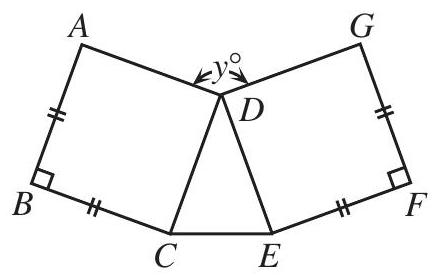 | Geometry | AI-MO/NuminaMath-1.5/olympiads | {'question_type': 'MCQ', 'problem_is_valid': 'Yes', 'solution_is_valid': 'Yes', 'synthetic': False} | Geometry | 2 |
Answer: $-\frac{29}{2}$ $\overrightarrow{A B}=-\frac{1}{2}|\overrightarrow{A B}|^{2}$ . Similarly, we get $\overrightarrow{O B} \cdot \overrightarrow{B C}=-\frac{1}{2}|\overrightarrow{B C}|^{2}, \overrightarrow{O C} \cdot \overrightarrow{C A}=-\frac{1}{2}|\overrightarrow{C A}|^{2}$, hence $\overrightarrow{O A} \cdot \o... | -\frac{29}{2} | 3. Suppose the side lengths of $\triangle A B C$ are $2,3,4$, and the circumcenter is 0, then $\overrightarrow{O A} \cdot \overrightarrow{O B}+\overrightarrow{O B} \cdot \overrightarrow{O C}+\overrightarrow{O C} \cdot \overrightarrow{O A}=$ | Geometry | AI-MO/NuminaMath-1.5/olympiads | {'question_type': 'math-word-problem', 'problem_is_valid': 'Yes', 'solution_is_valid': 'Yes', 'synthetic': False} | Geometry | 4.333333 |
[Solution] Let $\alpha$ and $\beta$ be the solutions of $x^{2}+m x+n=0$. Then, according to the problem, we have
$$
\left\{\begin{array}{rl}
-m = \alpha + \beta, \\
n & = \alpha \beta;
\end{array} \quad \left\{\begin{array}{rl}
-p & =\alpha^{3}+\beta^{3}, \\
q & =\alpha^{3} \beta^{3}.
\end{array}\right.\right.
$$
Sinc... | ^{3}-3n | 2・54 If the solutions of the equation $x^{2}+p x+q=0$ are the cubes of the solutions of the equation $x^{2}+m x+n=0$, then
(A) $p=m^{3}+3 m n$.
(B) $p=m^{3}-3 m n$.
(C) $p+q=m^{3}$.
(D) $\left(\frac{m}{n}\right)^{3}=\frac{p}{q}$.
(E) None of these.
(28th American High School Mathematics Examination, 1977) | Algebra | AI-MO/NuminaMath-1.5/olympiads | {'question_type': 'MCQ', 'problem_is_valid': 'Yes', 'solution_is_valid': 'Yes', 'synthetic': False} | General algebraic systems | 3 |
【Analysis】Before folding, the degree of $\angle C$ can be obtained by using the sum of the interior angles of a triangle. After folding, the degree of $\angle CDA$ can be obtained by using the sum of the exterior angles of a triangle and the sum of the interior angles of a quadrilateral.
【Solution】According to the ana... | 92 | 4. (10 points) As shown in the figure, fold a triangular paper piece $A B C$ so that point $C$ lands on the plane of triangle $A B C$, with the fold line being $D E$. Given $\angle A B E=74^{\circ}, \angle D A B=70^{\circ}, \angle C E B=20^{\circ}$, then $\angle C D A$ equals $\qquad$ . | Geometry | AI-MO/NuminaMath-1.5/olympiads | {'question_type': 'math-word-problem', 'problem_is_valid': 'Yes', 'solution_is_valid': 'Yes', 'synthetic': False} | Geometry | 3 |
Solution: (a) Let $P_{1}$ be the number of students who passed before the score increase, and $P_{2}$ be the number of students who passed after the score increase. From the information we have, we can write:
$$
66 N=71 P_{1}+56\left(N-P_{1}\right), \quad 71 N=75 P_{2}+59\left(N-P_{2}\right)
$$
From the first relatio... | 12,24,36 | 1. In a math test, $N<40$ people participate. The passing score is set at 65. The test results are as follows: the average score of all participants is 66, that of the promoted is 71, and that of the failed is 56. However, due to an error in the formulation of a question, all scores are increased by 5. At this point, t... | Algebra | AI-MO/NuminaMath-1.5/olympiads | {'question_type': 'math-word-problem', 'problem_is_valid': 'Yes', 'solution_is_valid': 'Yes', 'synthetic': False} | Number theory | 3.4 |
Compose a system of three equations with respect to the sides of a triangle. Use the equality $\sqrt{6}-\sqrt{2}=4 \cos 75^{\circ}$ when solving it.
## Solution
Let $C D$ be the height of the triangle. Denote $A B=c, B C=a, A C=b$. Then $S_{\triangle \mathrm{ABC}}=\frac{1}{2} A B \cdot C D=\frac{1}{2} c$. On the othe... | \sqrt{6}-\sqrt{2} | [Law of Cosines] [Law of Sines]
In an acute triangle $ABC$, the angle $\angle ACB = 75^{\circ}$, and the altitude dropped from this vertex is 1.
Find the radius of the circumscribed circle if it is known that the perimeter of triangle $ABC$ is $4 + \sqrt{6} - \sqrt{2}$. | Geometry | AI-MO/NuminaMath-1.5/olympiads | {'question_type': 'math-word-problem', 'problem_is_valid': 'Yes', 'solution_is_valid': 'Yes', 'synthetic': False} | Geometry | 4.333333 |
Establish a Cartesian coordinate system, with $A$ as the origin, $AB$ as the $x$-axis, $AC$ as the $y$-axis, and $AA_1$ as the $z$-axis, then $E\left(0,1, \frac{1}{2}\right), G\left(\frac{1}{2}, 0,1\right)$. Let $F\left(t_{1}, 0,0\right)\left(0<t_{1}<1\right), D\left(0, t_{2}, 0\right)\left(0<t_{2}<1\right)$, then $\ov... | [\frac{1}{\sqrt{5}},1) | 12.2.5 * In the right triangular prism $A_{1} B_{1} C_{1}-A B C$, $\angle B A C=\frac{\pi}{2}, A B=A C=A A_{1}=$ 1. Given that $G$ and $E$ are the midpoints of $A_{1} B_{1}$ and $C C_{1}$, respectively, and $D$ and $F$ are moving points on segments $A C$ and $A B$ (excluding the endpoints). If $G D \perp E F$, then the... | Geometry | AI-MO/NuminaMath-1.5/olympiads | {'question_type': 'MCQ', 'problem_is_valid': 'Yes', 'solution_is_valid': 'Yes', 'synthetic': False} | Geometry | 4.25 |
Solution. Let $x$ be the fifth part of the reference books, $y$ be the seventh part of all fiction books. Then on the first shelf, there are $-x+y+150$ books, and on the second shelf, there are $-4x+6y$ books. From the condition of the problem, the number of books on the shelves is equal, therefore, $x+y+150=4x+6y$, fr... | 267 | 3. Each participant in the school charity event brought either one encyclopedia, or three fiction books, or two reference books. In total, 150 encyclopedias were collected. After the event, two bookshelves in the library were filled, with an equal number of books on each. On the first shelf, there was one fifth of all ... | Algebra | AI-MO/NuminaMath-1.5/olympiads | {'question_type': 'math-word-problem', 'problem_is_valid': 'Yes', 'solution_is_valid': 'Yes', 'synthetic': False} | General algebraic systems | 2.8 |
Answer: 400.
Solution. Consider ten consecutive natural numbers. We will prove that no more than four of them are selected. If at least five numbers are selected, then three of them have the same parity, but then their pairwise differences cannot be only 2 and 8. Indeed, if $a<b<c$, then $b-a=2$ and $c-a=8$, but then ... | 400 | 2. What is the maximum number of different numbers from 1 to 1000 that can be chosen so that the difference between any two chosen numbers is not equal to any of the numbers 4, 5, 6. | Combinatorics | AI-MO/NuminaMath-1.5/olympiads | {'question_type': 'math-word-problem', 'problem_is_valid': 'Yes', 'solution_is_valid': 'Yes', 'synthetic': False} | null | 2 |
3. (C)
If the line $l$ passes through the point $(a, 0)$ and through two rational points $\left(x_{1}, y_{1}\right),\left(x_{2}, y_{2}\right)$, then it must be that $x_{1} \neq x_{2}$.
Otherwise, the equation of $l$ would be $x=a$, and thus $x_{1}=x_{2}=a$, which contradicts the fact that $\left(x_{1}, y_{1}\right)$,... | C | 3. In the Cartesian coordinate system, a point whose both coordinates are rational numbers is called a rational point. If $a$ is an irrational number, then among all lines passing through the point $(a, 0)$,
(A) there are infinitely many lines, each of which contains at least two rational points;
(B) there are exactly ... | Number Theory | AI-MO/NuminaMath-1.5/olympiads | {'question_type': 'MCQ', 'problem_is_valid': 'Yes', 'solution_is_valid': 'Yes', 'synthetic': False} | Number theory | 3 |
Solution: We have
$$2 \sum_{c y c} \frac{a}{b}=\left(\sum_{c y c} \frac{a}{b}+\sum_{c y c} \frac{b}{a}\right)+\left(\sum_{c y c} \frac{a}{b}-\sum_{c y c} \frac{b}{a}\right)=\frac{\sum_{s y m} a^{2}(b+c)}{a b c}+\frac{(a-b)(b-c)(c-a)}{a b c}$$
Thus, the inequality equivalent to
$$\sum_{c y c} \frac{a}{b}+2 k \frac{a b+... | 3 \sqrt[3]{4}-2 | Problem 24 Let $a, b, c$ be nonnegative real numbers. Find the best constant $k$ such that the inequality always holds
$$\frac{a}{b}+\frac{b}{c}+\frac{c}{a}+k \frac{a b+b c+c a}{a^{2}+b^{2}+c^{2}} \geq 3+k$$ | Inequalities | AI-MO/NuminaMath-1.5/inequalities | {'question_type': 'math-word-problem', 'problem_is_valid': 'Yes', 'solution_is_valid': 'Yes', 'synthetic': False} | General algebraic systems | 7 |
# Solution.
Since it is necessary to find the largest number of three-digit numbers that are multiples of 4, the deviation between the members should be minimal. Note that the arithmetic
progression with a difference of $d=2$, defined by the formula $a_{k}=2 k$, satisfies the equality $a_{k+2}=3 a_{k+1}-2 a_{k}-2$.
I... | 225 | Task 4. (20 points) A finite increasing sequence of natural numbers $a_{1}, a_{2}, \ldots, a_{n}(n \geq 3)$ is given, and for all $\kappa \leq n-2$ the equality $a_{k+2}=3 a_{k+1}-2 a_{k}-2$ holds. The sequence must contain $a_{k}=2022$. Determine the maximum number of three-digit numbers, divisible by 4, that this seq... | Algebra | AI-MO/NuminaMath-1.5/olympiads | {'question_type': 'math-word-problem', 'problem_is_valid': 'Yes', 'solution_is_valid': 'Yes', 'synthetic': False} | Number theory | 2.25 |
【Analysis】Let's assume the four input numbers are $\mathrm{a}<\mathrm{b}<\mathrm{c}<\mathrm{d}$. Since the final output is the same, let's assume this result is $\mathrm{m}$. If $\mathrm{m}$ is an even number, since $4 \mathrm{k}+1$ is odd, odd $\neq$ even, so the final input result must also be an even number, which i... | 680 | 13. The left figure below is a strange black box. This black box has one input port and one output port. When we input a number into the input port, a number result will be produced at the output port, following these rules:
(1) If the input is an odd number $\mathrm{k}$, the output is $4 \mathrm{k}+1$.
(2) If the inpu... | Number Theory | AI-MO/NuminaMath-1.5/olympiads | {'question_type': 'math-word-problem', 'problem_is_valid': 'Yes', 'solution_is_valid': 'Yes', 'synthetic': False} | Number theory | 5 |
Answer: 38 overtakes.
Solution. First, let's prove that no more than 38 overtakes occurred. Note that between the start and the first overtake, and between two consecutive overtakes, at least one of the teams must have changed the runner. There were 19 changes of runners in each team, meaning a total of 38 changes, so... | 38 | 2. In the relay race Moscow - Petushki, two teams of 20 people each participated. Each team divided the distance into 20 not necessarily equal segments and distributed them among the participants so that each ran exactly one segment (the speed of each participant is constant, but the speeds of different participants ma... | Combinatorics | AI-MO/NuminaMath-1.5/olympiads | {'question_type': 'math-word-problem', 'problem_is_valid': 'Yes', 'solution_is_valid': 'Yes', 'synthetic': False} | Combinatorics | 5 |
The ratio of the areas of similar triangles is equal to the square of the similarity coefficient.
## Solution
Let ${ }^{B C} /{ }_{A D}=3 / 5$. The similarity coefficient of triangles $M B C$ and $M A D$ is $3 / 5$. Therefore, $S_{M B C}=9 / 25 S_{M A D}=18$. Hence, $S_{A B C D}=S_{M A D}-S_{M B C}=50-18=32$.
$, if its bases are in the ratio $5:3$, and the area of triangle $ADM$ is 50, where $M$ is the point of intersection of lines $AB$ and $CD$. | Geometry | AI-MO/NuminaMath-1.5/olympiads | {'question_type': 'math-word-problem', 'problem_is_valid': 'Yes', 'solution_is_valid': 'Yes', 'synthetic': False} | Geometry | 2.5 |
5. 31.5
square meters
5.【Solution】The surface area of the object is exactly equal to the surface area of a large cylinder plus the lateral surface areas of the medium and small cylinders. That is,
$$
\begin{aligned}
& 2 \times \pi \times 1.5^{2}+2 \times \pi \times 1.5 \times 1+2 \times \pi \times 1 \times 1+2 \times ... | 31.5 | 5. (As shown in the right figure) Three cylinders with heights of 1 meter and base radii of 1.5 meters, 1 meter, and 0.5 meters respectively are combined to form an object. Find the surface area of this object (take $\pi=3$). | Geometry | AI-MO/NuminaMath-1.5/olympiads | {'question_type': 'math-word-problem', 'problem_is_valid': 'Yes', 'solution_is_valid': 'Yes', 'synthetic': False} | Geometry | 4 |
Answer: 16.
Solution. Divide the $5 \times 5$ square without the central cell into four $2 \times 3$ rectangles, and each of these into two $1 \times 3$ rectangles.
This results in 8 rectan... | 16 | Problem 10.1. In each cell of a $5 \times 5$ table, a natural number is written in invisible ink. It is known that the sum of all the numbers is 200, and the sum of three numbers inside any $1 \times 3$ rectangle is 23. What is the central number in the table?
$.
Let's find the maximum. We can assume that $x_{1} \geq x_{2} \geq x_{3} \geq 0$. We will prove two inequalities:
$$
\begin{gathered}
\sqrt{x_{1}^{2}+x_{2} x_{3}} \leq x_{1}+\frac{x_{3}}{2} \\
\sq... | 3 | # Problem 1.
Three electric generators have powers $x_{1}, x_{2}, x_{3}$, the total power of all three does not exceed 2 MW. In the power system with such generators, a certain process is described by the function
$$
f\left(x_{1}, x_{2}, x_{3}\right)=\sqrt{x_{1}^{2}+x_{2} x_{3}}+\sqrt{x_{2}^{2}+x_{1} x_{3}}+\sqrt{x_{... | Algebra | AI-MO/NuminaMath-1.5/olympiads | {'question_type': 'math-word-problem', 'problem_is_valid': 'Yes', 'solution_is_valid': 'Yes', 'synthetic': False} | null | 4 |
Let $p$ be a prime number. Then for $x=y=p$ the given condition gives us that the number $f^{2}(p)+3 p f(p)$ is a perfect square. Then, $f^{2}(p)+3 p f(p)=k^{2}$ for some positive integer $k$. Completing the square gives us that $(2 f(p)+3 p)^{2}-9 p^{2}=4 k^{2}$, or
$$
(2 f(p)+3 p-2 k)(2 f(p)+3 p+2 k)=9 p^{2} .
$$
S... | f(x)=x | Find all functions $f: \mathbf{Z}_{>0} \rightarrow \mathbb{Z}_{>0}$ such that the number $x f(x)+f^{2}(y)+2 x f(y)$ is a perfect square for all positive integers $x, y$. | Number Theory | AI-MO/NuminaMath-1.5/olympiads_ref | {'question_type': 'math-word-problem', 'problem_is_valid': 'Yes', 'solution_is_valid': 'Yes', 'synthetic': False} | Number theory | 10 |
Let $C D$ be a diameter, $O$ be the midpoint of $C D$, and $D A, A B$ and $B C$ be chords. Then the required area is equal to the area of
sector $A O B$,
## Solution
Let $C D$ be a diameter, $O$ be the midpoint of $C D$, and $D A, A B$ and $B C$ be chords. Triangles $A O D, A O B$ and $B O C$ are equilateral, $\angl... | \frac{\pir^{2}}{6} | A semicircle of radius $r$ is divided into 3 equal parts by points, and the points of division are connected by chords to one end of the diameter that spans this semicircle. Find the area of the figure bounded by the two chords and the arc between them. | Geometry | AI-MO/NuminaMath-1.5/olympiads | {'question_type': 'math-word-problem', 'problem_is_valid': 'Yes', 'solution_is_valid': 'Yes', 'synthetic': False} | Geometry | 2.2 |
[Solution] Let $y=-x$, then $y \in\left(0, \frac{1}{2}\right)$, and
$$
\begin{array}{l}
a_{1}=\cos (\sin y \pi), \quad a_{2}=\sin (\cos y \pi), \quad a_{3}=\cos (1-y) \pi<0 . \\
\because \quad \sin y \pi+\cos y \pi=\sqrt{2} \sin \left(y \pi+\frac{\pi}{4}\right) \leqslant \sqrt{2} \leqslant \frac{\pi}{2}, \\
\therefore ... | A | 9.26 Let $x \in\left(-\frac{1}{2}, 0\right)$, then $a_{1}=\cos (\sin x \pi), a_{2}=\sin (\cos x \pi)$, $a_{3}=\cos (x+1) \pi$ have the following size relationship:
(A) $a_{3}<a_{2}<a_{1}$.
(B) $a_{1}<a_{3}<a_{2}$.
(C) $a_{3}<a_{1}<a_{2}$.
(D) $a_{2}<a_{3}<a_{1}$.
(China High School Mathematics League, 1996) | Algebra | AI-MO/NuminaMath-1.5/olympiads | {'question_type': 'MCQ', 'problem_is_valid': 'Yes', 'solution_is_valid': 'Yes', 'synthetic': False} | Real functions | 5 |
Solution. The areas of figures $\Omega$ bounded by closed piecewise-smooth lines $L$ without self-intersections can be calculated using formula (2.65):
$$
\mu(\Omega)=\oint_{L}-y d x+x d y
$$
where the contour $L$ is traversed counterclockwise.
a) In the case of a cardioid $t \in [0, 2\pi]$, $d x = (-2 \sin t + 2 \s... | 12\pi,\frac{3\pi^2}{4},\frac{16}{15} | 2.6. Find the area of the figure bounded by the given line:
a) $x=2 \cos t-\cos 2 t, y=2 \sin t-\sin 2 t$ (cardioid);
b) $x=a \cos ^{3} t, y=a \sin ^{3} t, a>0$ (astroid);
c) $y^{2}=x^{2}+x^{3}$. | Calculus | AI-MO/NuminaMath-1.5/olympiads | {'question_type': 'math-word-problem', 'problem_is_valid': 'Yes', 'solution_is_valid': 'Yes', 'synthetic': False} | Geometry | 3.6 |
A number that is divisible by 5 and less than $5^{x}$ is $5^{x-1}$. The
$$
5^{x}-5^{x-1}=4 \cdot 5^{x-1}
$$
difference gives the number of numbers that do not share a common divisor with $5^{x}$. Thus:
$$
\begin{gathered}
4 \cdot 5^{x-1}=7812000 \\
5^{x-1}=1953125=5^{9}
\end{gathered}
$$
From this, it follows that
... | 10 | Determine $x$ from the condition that the integer of the form $5^{x}$ is preceded by the number 7812500, which has no common divisor with $5^{x}$. | Number Theory | AI-MO/NuminaMath-1.5/olympiads | {'question_type': 'math-word-problem', 'problem_is_valid': 'Yes', 'solution_is_valid': 'Yes', 'synthetic': False} | null | 10 |
A $10 \mathrm{~cm}$ by $10 \mathrm{~cm}$ board has 9 rows of 9 holes, or $9 \times 9=81$ pegs in total.
Each hole on the 2 main diagonals has a peg in it.
There are 9 holes on each diagonal, with the centre hole on both diagonals, since there is an odd number of holes in each row.
Therefore, the total number of hole... | 64 | A $5 \mathrm{~cm}$ by $5 \mathrm{~cm}$ pegboard and a $10 \mathrm{~cm}$ by $10 \mathrm{~cm}$ pegboard each have holes at the intersection of invisible horizontal and vertical lines that occur in $1 \mathrm{~cm}$ intervals from each edge. Pegs are placed into the holes on the two main diagonals of both pegboards. The $5... | Combinatorics | AI-MO/NuminaMath-1.5/olympiads | {'question_type': 'math-word-problem', 'problem_is_valid': 'Yes', 'solution_is_valid': 'Yes', 'synthetic': False} | Combinatorics | 1 |
2. $\left[\frac{\sqrt{2}}{3}, 1\right)$.
As shown in Figure 3, take the midpoint $D$ of $B C$, and connect $O D$ and $A D$.
Figure 3
Since the circumcenter of $\triangle A B C$ is $O$, we have
$O D \perp B C$.
$$
\begin{array}{l}
\text { By } \overrightarrow{A O} \cdot \overrightarrow{B C}=(\overrightarrow{A D}+\over... | [\frac{\sqrt{2}}{3},1) | 2. Given that the circumcenter of $\triangle A B C$ is $O$, and
$$
\overrightarrow{A O} \cdot \overrightarrow{B C}=3 \overrightarrow{B O} \cdot \overrightarrow{A C}+4 \overrightarrow{C O} \cdot \overrightarrow{B A} \text {. }
$$
Then the range of $\cos B$ is $\qquad$ | Geometry | AI-MO/NuminaMath-1.5/olympiads | {'question_type': 'math-word-problem', 'problem_is_valid': 'Yes', 'solution_is_valid': 'Yes', 'synthetic': False} | Geometry | 4.5 |
$A B=4 \mathrm{~cm}, B C=5 \mathrm{~cm}$ and $D E=3 \mathrm{~cm} . E F=c \mathrm{~cm}$
Draw $B G \perp D F, C H \perp D F$
$D G=A B=4 \mathrm{~cm}, G H=B C=5 \mathrm{~cm}$
$E G=D G-D E=4 \mathrm{~cm}-3 \mathrm{~cm}=1 \mathrm{~cm}$
Let $O$ be the centre.
Let $M$ be the foot of perpendicular of $O$ on $E F$ and produce $... | 7\mathrm{~} | G3.3 In Figure 2, a rectangle intersects a circle at points $B, C, E$ and $F$. Given that $A B=4 \mathrm{~cm}, B C=5 \mathrm{~cm}$ and $D E=3 \mathrm{~cm}$. If $E F=c \mathrm{~cm}$, find the value of $c$. | Geometry | AI-MO/NuminaMath-1.5/olympiads | {'question_type': 'math-word-problem', 'problem_is_valid': 'Yes', 'solution_is_valid': 'Yes', 'synthetic': False} | Geometry | 3.4 |
. Only one of the triangles in the tiling is acute. Indeed, the fundamental remark is that acute triangles are recognized as those that have the center of their circumscribed circle as an interior point. Here, all the triangles in the tiling have the same circumscribed circle, namely the circumscribed circle of the reg... | 1 | . A convex regular polygon with 1997 vertices has been decomposed into triangles using diagonals that do not intersect internally. How many of these triangles are acute? | Geometry | AI-MO/NuminaMath-1.5/olympiads | {'question_type': 'math-word-problem', 'problem_is_valid': 'Yes', 'solution_is_valid': 'Yes', 'synthetic': False} | Combinatorics | 2.6 |
25. E Each floor has 35 rooms. On every floor except floor 2 , the digit 2 will be used for rooms ' $n 02$ ', ' $n 12$ ', ' $n 20$ ' to ' $n 29$ ' (including ' $n 22$ ') and ' $n 32$ '. Hence the digit 2 will be used 14 times on each floor except floor 2 . On floor 2, the digit 2 will be used an extra 35 times as the f... | 105 | 25. The room numbers of a hotel are all three-digit numbers. The first digit represents the floor and the last two digits represent the room number. The hotel has rooms on five floors, numbered 1 to 5 . It has 35 rooms on each floor, numbered $\mathrm{n} 01$ to $\mathrm{n} 35$ where $\mathrm{n}$ is the number of the fl... | Combinatorics | AI-MO/NuminaMath-1.5/olympiads | {'question_type': 'MCQ', 'problem_is_valid': 'Yes', 'solution_is_valid': 'Yes', 'synthetic': False} | Combinatorics | 1.25 |
3. Answer: 5 trucks. Indeed, 5 trucks will be always enough. First four trucks can carry at least 8 tons of stones and the fifth will be able to carry all the rest. If there were 13 stones weighing $10 / 13$ tons each, then each truck would be able to carry only 3 of them, hence five cars might be needed in this case. | 5 | 3. Several pounamu stones weigh altogether 10 tons and none of them weigh more than 1 tonne. A truck can carry a load which weight is at most 3 tons. What is the smallest number of trucks such that bringing all stones from the quarry will be guaranteed? | Combinatorics | AI-MO/NuminaMath-1.5/olympiads | {'question_type': 'math-word-problem', 'problem_is_valid': 'Yes', 'solution_is_valid': 'Yes', 'synthetic': False} | Operations research, mathematical programming | 4.5 |
Let $\alpha$ be a parameter such that
$$\begin{aligned}
f^{2}(x) & =\frac{1}{\alpha^{2}} \sin ^{2} x(a \alpha+\alpha \cos x)^{2} \leqslant \frac{1}{\alpha^{2}} \sin ^{2} x\left(\alpha^{2}+\cos ^{2} x\right)\left(a^{2}+\alpha^{2}\right) \\
& \leqslant \frac{1}{\alpha^{2}}\left(\frac{\sin ^{2} x+\alpha^{2}+\cos ^{2} x}{2... | \frac{\sqrt{a^{4}+8 a^{2}}-a^{2}+4}{8} \cdot \sqrt{\frac{\sqrt{a^{4}+8 a^{2}}+a^{2}+2}{2}} | Example 4 Let $a$ be a real number, find the maximum value of the function $f(x)=|\sin x(a+\cos x)|(x \in \mathbf{R})$. | Algebra | AI-MO/NuminaMath-1.5/inequalities | {'question_type': 'math-word-problem', 'problem_is_valid': 'Yes', 'solution_is_valid': 'Yes', 'synthetic': False} | Real functions | 4.25 |
Solution. Multiply by $\sin \pi x$. All $x=n, n \in \mathbb{Z}$ need to be removed from the answer, as they are not roots of the original equation. Next, using the equality $8 \sin \pi x \cos \pi x \cos 2 \pi x \cos 4 \pi x=\sin 8 \pi x$, we find
$$
\begin{aligned}
\sin 8 \pi x \cdot \cos 2 \pi x & =\sin \pi x \cdot \... | 3.5 | 8-1. Find all common points of the graphs
$$
y=8 \cos \pi x \cdot \cos ^{2} 2 \pi x \cdot \cos 4 \pi x \quad \text { and } \quad y=\cos 9 \pi x
$$
with abscissas belonging to the segment $x \in[0 ; 1]$. In your answer, specify the sum of the abscissas of the found points. | Algebra | AI-MO/NuminaMath-1.5/olympiads | {'question_type': 'math-word-problem', 'problem_is_valid': 'Yes', 'solution_is_valid': 'Yes', 'synthetic': False} | Real functions | 3.5 |
【Solution】Solution: The total number of matches played, $4 \times 6 \div 2=12$ (matches), among which 4 matches were draws, the number of matches with a winner is: $12-4=8$ (matches), the total points scored by the six teams: $3 \times 8+2 \times 4=32$ (points), because, the top three teams scored at least: $7+8+9=24$ ... | 3,1 | 13. (8 points) Six football teams are playing a round-robin tournament, where each team plays against every other team. If a match ends in a draw, each team gets 1 point; otherwise, the winning team gets 3 points and the losing team gets 0 points. Now, after four rounds (each team has played 4 matches), the total point... | Combinatorics | AI-MO/NuminaMath-1.5/olympiads | {'question_type': 'math-word-problem', 'problem_is_valid': 'Yes', 'solution_is_valid': 'Yes', 'synthetic': False} | null | 4 |
Solution.
Let $x$ be the speed of the oncoming train.
According to the condition, $(40+x) \cdot \frac{3}{3600}=75 \cdot 10^{-3}$, from which $x=50($ km $/ h)$.
Answer: $50 \mathrm{km} /$ h. | 50\mathrm{}/\mathrm{} | 13.278. A passenger on a train knows that the speed of this train on this section of the track is 40 km/h. As soon as a passing train started to go by the window, the passenger started a stopwatch and noticed that the passing train took $3 \mathrm{s}$ to pass by the window. Determine the speed of the passing train, giv... | Algebra | AI-MO/NuminaMath-1.5/olympiads | {'question_type': 'math-word-problem', 'problem_is_valid': 'Yes', 'solution_is_valid': 'Yes', 'synthetic': False} | Mechanics of particles and systems | 2.25 |
$2020$ | 2020 | 4. Given that when $x=1$, $4 a x^{3}+3 b x^{2}-2 c x=8$, and $3 a x^{3}+2 b x^{2}-c x=-6$, then, when $x=-1$, the value of $10 a x^{3}-7 b x^{2}-4 c x+2016$ is $\qquad$ | Algebra | AI-MO/NuminaMath-1.5/olympiads | {'question_type': 'math-word-problem', 'problem_is_valid': 'Yes', 'solution_is_valid': 'Yes', 'synthetic': False} | null | 3 |
Answer: $n=65$.
Solution. First, let's make three observations.
1) $n$ is odd. Indeed, suppose $n$ is even. Among five numbers, there are always three numbers of the same parity, and by the condition, they must be pairwise connected. But there are no cycles of length 3 in the picture.
2) If $d$ is a divisor of $n$, t... | 65 | 1. In the picture, several circles are drawn, connected by segments. Tanya chooses a natural number n and places different natural numbers in the circles so that for all these numbers the following property holds:
if numbers a and b are not connected by a segment, then the sum $a^{2}+b^{2}$ must be coprime with n; if ... | Number Theory | AI-MO/NuminaMath-1.5/olympiads | {'question_type': 'math-word-problem', 'problem_is_valid': 'Yes', 'solution_is_valid': 'Yes', 'synthetic': False} | Number theory | 7.75 |
Answer: $\frac{7}{24}$ From the starting point of $(1,0)$, there is a $\frac{1}{4}$ chance we will go directly to $(1,1)$, a $\frac{1}{2}$ chance we will end at $(2,0)$ or $(1,-1)$, and a $\frac{1}{4}$ chance we will go to $(0,0)$. Thus, if $p$ is the probability that we will reach $(1,1)$ from $(0,0)$, then the desire... | \frac{7}{24} | 4. [4] An ant starts at the point $(1,0)$. Each minute, it walks from its current position to one of the four adjacent lattice points until it reaches a point $(x, y)$ with $|x|+|y| \geq 2$. What is the probability that the ant ends at the point $(1,1)$ ? | Combinatorics | AI-MO/NuminaMath-1.5/olympiads | {'question_type': 'math-word-problem', 'problem_is_valid': 'Yes', 'solution_is_valid': 'Yes', 'synthetic': False} | Probability theory and stochastic processes | 4 |
Answer. For 5 rubles.
Solution. Let's mark the numbers $17, 19, 23$, and 29, spending four rubles. Then mark the number 2, spending another ruble. After this, we can freely mark all even numbers (since they are divisible by 2), and then all odd numbers not exceeding 15 - for any of them (let's say for the number $n$),... | 5 | Problem 3. The numbers $2,3,4, \ldots, 29,30$ are written on the board. For one ruble, you can mark any number. If a number is already marked, you can freely mark its divisors and numbers that are multiples of it. What is the minimum number of rubles needed to mark all the numbers on the board? [6 points]
(I.V. Yashch... | Number Theory | AI-MO/NuminaMath-1.5/olympiads | {'question_type': 'math-word-problem', 'problem_is_valid': 'Yes', 'solution_is_valid': 'Yes', 'synthetic': False} | Combinatorics | 4.75 |
4. A
Math, Chinese, English, Chemistry, the failure rates of these 4 subjects are: $1\%, 2\%, 4\%, 8\%$; the sum is $15\%$. Moreover, for those who fail at least two subjects, among the above 4 subjects, at least one subject is failed, which is no less than $15\%$, so the number of people who pass at least 4 subjects ... | 85 | 4. A prestigious school has the following pass rates in a college entrance examination simulation:
Math: $99 \%$
Chinese: $98 \%$
English: $96 \%$
Chemistry: $92 \%$
Comprehensive: $84 \%$
Then the minimum possible value for the number of people who pass at least 4 subjects is ( ).
A. $85 \%$
B. $84.5 \%$
C. $86 \%$... | Combinatorics | AI-MO/NuminaMath-1.5/olympiads | {'question_type': 'MCQ', 'problem_is_valid': 'Yes', 'solution_is_valid': 'Yes', 'synthetic': False} | Game theory, economics, social and behavioral sciences | 4.5 |
【Analysis】Since $\frac{A E}{A B}=\frac{A F}{A C}=\frac{1}{3}$, therefore $\mathrm{EF} / / \mathrm{BC}$
Therefore $\mathrm{S}_{\mathrm{EBD}}=\mathrm{S}_{\mathrm{FBD}}=\mathrm{S}_{1} \rightarrow \mathrm{S}_{1}+\mathrm{S}_{2}=\mathrm{S}_{\mathrm{EBC}}=\frac{2}{3} \mathrm{~S}_{\mathrm{ABC}}=40$
When the sum is constant, th... | 400 | 5. As shown in the figure, the area of $\triangle \mathrm{ABC}$ is $60, \mathrm{E}$ and $\mathrm{F}$ are points on $\mathrm{AB}$ and $\mathrm{AC}$ respectively, satisfying $\mathrm{AB}=3 \mathrm{AE}, \mathrm{AC}=3 \mathrm{AF}$, point $D$ is a moving point on segment $B C$, let the area of $\triangle F B D$ be $S_{1}$, ... | Geometry | AI-MO/NuminaMath-1.5/olympiads | {'question_type': 'math-word-problem', 'problem_is_valid': 'Yes', 'solution_is_valid': 'Yes', 'synthetic': False} | Geometry | 5 |
6 $a=0$ Hint: Let $\cos x=-1, \sin x=0, a \sin ^{2} x+\cos x \geqslant$ $a^{2}-1$, we get $a^{2} \leqslant 0$. And when $a=0$, the original inequality obviously always holds. Therefore, $a=0$. | 0 | 6 If the inequality $a \sin ^{2} x+\cos x \geqslant a^{2}-1$ holds for any $x \in \mathbf{R}$, then the range of real number $a$ is $\qquad$. | Inequalities | AI-MO/NuminaMath-1.5/olympiads | {'question_type': 'math-word-problem', 'problem_is_valid': 'Yes', 'solution_is_valid': 'Yes', 'synthetic': False} | Real functions | 3.333333 |
5. Vova has 19 math grades in his journal, all twos and threes, and the first four grades are twos. It turned out that among the quartets of consecutive grades, all 16 possible combinations of four twos and threes are present. What are Vova's last four grades?
ANSWER. 3222.
SOLUTION. Note that there are exactly 16 qu... | 3222 | 5. Vova has 19 math grades in his journal, all twos and threes, and the first four grades are twos. It turned out that among the quartets of consecutive grades, all 16 possible combinations of four twos and threes are present. What are Vova's last four grades? | Combinatorics | AI-MO/NuminaMath-1.5/olympiads | {'question_type': 'math-word-problem', 'problem_is_valid': 'Yes', 'solution_is_valid': 'Yes', 'synthetic': False} | Combinatorics | 5 |
}
For the lengths \(A B=c, D C=h, A D=q, D B=p\) it holds that
\[
h=\frac{2}{5} c \quad(1) \quad \text { and } \quad p+q=c \quad(2) \quad \text { and } \quad q<p
\]
Furthermore, according to the height theorem \(p g=h^{2} \quad\) (4). Substituting \(h\) from (1) into (4) yields
\[
p q=\frac{4}{25} c^{2}
\]
Substit... | 1:4 | \section*{Problem 1 - 211021}
In a right-angled triangle \(A B C\), the height \(D C\) perpendicular to the hypotenuse \(A B\) is exactly \(\frac{2}{5}\) times as long as the hypotenuse \(A B\). For the foot of the perpendicular \(D\), it holds that \(A D < D B\).
In what ratio \(A D: D B\) does it divide the hypoten... | Geometry | AI-MO/NuminaMath-1.5/olympiads | {'question_type': 'math-word-problem', 'problem_is_valid': 'Yes', 'solution_is_valid': 'Yes', 'synthetic': False} | Geometry | 2 |
Solution.
$$
\begin{aligned}
& \sin ^{2}\left(\alpha-\frac{3 \pi}{2}\right)\left(1-\operatorname{tg}^{2} \alpha\right) \operatorname{tg}\left(\frac{\pi}{4}+\alpha\right) \cos ^{-2}\left(\frac{\pi}{4}-\alpha\right)= \\
& =\left(\sin \left(\frac{3}{2} \pi-\alpha\right)\right)^{2}\left(1-\operatorname{tg}^{2} \alpha\righ... | 2 | 3.081. $\sin ^{2}\left(\alpha-\frac{3 \pi}{2}\right)\left(1-\operatorname{tg}^{2} \alpha\right) \operatorname{tg}\left(\frac{\pi}{4}+\alpha\right) \cos ^{-2}\left(\frac{\pi}{4}-\alpha\right)$. | Algebra | AI-MO/NuminaMath-1.5/olympiads | {'question_type': 'math-word-problem', 'problem_is_valid': 'Yes', 'solution_is_valid': 'Yes', 'synthetic': False} | Real functions | 2 |
7. $\pi f(x)=\cos 2 x-2 \sqrt{3} \sin x \cos x=\cos 2 x-\sqrt{3} \sin 2 x=2 \cos \left(2 x+\frac{\pi}{3}\right)$ Therefore, $T=\pi$ | \pi | 7. (2004 National College Entrance Examination - Beijing Paper) The smallest positive period of the function $f(x)=\cos 2 x-2 \sqrt{3} \sin x \cos x$ is | Algebra | AI-MO/NuminaMath-1.5/olympiads | {'question_type': 'math-word-problem', 'problem_is_valid': 'Yes', 'solution_is_valid': 'Yes', 'synthetic': False} | Functional analysis | 5.666667 |
Answer: 974
Solution: $A B^{2}=1+(b-a)^{2}, B C^{2}=1+(c-b)^{2}, A C^{2}=4+(c-a)^{2}$.
If triangle $A B C$ is a right triangle with hypotenuse $A C$, then by the Pythagorean theorem $A C^{2}=A B^{2}+B C^{2}, 1+(b-a)^{2}+1+(b-c)^{2}=4+(a-c)^{2}$, which simplifies to $(b-a)(b-c)=1$. Since both factors are integers, we ... | 974 | 8. In how many different ways can integers $a, b, c \in [1,100]$ be chosen so that the points with coordinates $A(-1, a), B(0, b)$, and $C(1, c)$ form a right triangle? | Combinatorics | AI-MO/NuminaMath-1.5/olympiads | {'question_type': 'math-word-problem', 'problem_is_valid': 'Yes', 'solution_is_valid': 'Yes', 'synthetic': False} | Combinatorics | 8.5 |
II. (50 points)
Make a trigonometric substitution. Since $|a|>1$, we can set
$$
a=\frac{1}{\cos \theta}(\theta \in(0,2 \pi)) \text {. }
$$
Then $b=\frac{a^{2}}{2-a^{2}}=\frac{\frac{1}{\cos ^{2} \theta}}{2-\frac{1}{\cos ^{2} \theta}}=\frac{1}{\cos ^{2} \theta}$,
Similarly, $c=\frac{1}{\cos ^{4} \theta}, a=\frac{1}{\cos... | 6,-4,-6 | II. (50 points $\}$
$a, b, c \in \mathbf{R}$. Satisfy $|a|>1,|b|>1,|c|>1$ and $b=\frac{a^{2}}{2-a^{2}}, c=\frac{b^{2}}{2-b^{2}}, a=$ $\frac{c^{2}}{2-c^{2}}$. Find all possible values of $a+b+c$. | Algebra | AI-MO/NuminaMath-1.5/olympiads | {'question_type': 'math-word-problem', 'problem_is_valid': 'Yes', 'solution_is_valid': 'Yes', 'synthetic': False} | Algebraic geometry | 6.5 |
[Solution] From the given, we have $x y=2000+x+y$,
which means
$$
(x-1)(y-1)=2001=3 \cdot 23 \cdot 29 \text {. }
$$
Since $x$ and $y$ are both two-digit numbers, we have
$$
\begin{array}{l}
(x-1)(y-1)=29 \cdot 69, \\
(x-1)(y-1)=23 \cdot 87,
\end{array}
$$
which gives
$$
\left\{\begin{array} { l }
{ x - 1 = 2 9 , } \... | 30,70\text{,or}24,88 | $10 \cdot 7$ Let $x$ and $y$ be two natural numbers with two digits, and $x<y$. The product $xy$ is a four-digit number. The first digit is 2, and if this first digit 2 is removed, the remaining number is exactly $x+y$, for example $x=30, y=70$, besides this pair, there is another pair of numbers with the above propert... | Number Theory | AI-MO/NuminaMath-1.5/olympiads | {'question_type': 'math-word-problem', 'problem_is_valid': 'Yes', 'solution_is_valid': 'Yes', 'synthetic': False} | null | 4.25 |
【Analysis and Solution】
Number Theory, Remainder.
(1) If the 40 odd numbers taken out contain "odd numbers with a units digit of 5"; $5 \times$ odd number has a units digit of 5;
the units digit of the product is 5.
(2) If the 40 odd numbers taken out do not contain "odd numbers with a units digit of 5"; then we need t... | 1or5 | 【Question 17】
From $1,2, \cdots, 100$, if you arbitrarily take out 40 odd numbers, the possible unit digit of their product is $\qquad$ - | Number Theory | AI-MO/NuminaMath-1.5/olympiads | {'question_type': 'math-word-problem', 'problem_is_valid': 'Yes', 'solution_is_valid': 'Yes', 'synthetic': False} | Number theory | 2 |
Answer: 4.5
Solution. Let's choose any five people standing in a circle in a row, with the outermost being boys. Let their numbers be $x, x y, y, y z, z$. Then $y=x y+y z$. Since $y \neq 0$, we can divide by it, obtaining $x+z=1$. Thus, the sum of any two numbers said by boys standing three apart is 1.
Let the boys s... | 4.5 | Problem 5. Six boys and six girls stood in a circle, alternating. Each of them wrote a non-zero number in their notebook. It is known that each number written by a boy is equal to the sum of the numbers written by the adjacent girls, and each number written by a girl is equal to the product of the numbers written by th... | Algebra | AI-MO/NuminaMath-1.5/olympiads | {'question_type': 'math-word-problem', 'problem_is_valid': 'Yes', 'solution_is_valid': 'Yes', 'synthetic': False} | General algebraic systems | 4.5 |
## Solution
In the section of the given figure by the plane $z=$ const, there is an ellipse:
$$
\begin{aligned}
& \frac{x^{2}}{16}+\frac{y^{2}}{9}=\frac{64-z^{2}}{64} \\
& \frac{x^{2}}{16 \cdot \frac{64-z^{2}}{64}}+\frac{y^{2}}{9 \cdot \frac{64-z^{2}}{64}}=1 \rightarrow a=\frac{1}{2} \sqrt{64-z^{2}} ; b=\frac{3}{8} \... | 44\pi | ## Problem Statement
Calculate the volumes of the bodies bounded by the surfaces.
$$
\frac{x^{2}}{16}+\frac{y^{2}}{9}+\frac{z^{2}}{64}=1, z=4, z=0
$$ | Calculus | AI-MO/NuminaMath-1.5/olympiads | {'question_type': 'math-word-problem', 'problem_is_valid': 'Yes', 'solution_is_valid': 'Yes', 'synthetic': False} | Geometry | 3.333333 |
If $a_{1}, a_{2}, a_{3}$ meet the conditions, then $a_{1}^{\prime}=a_{1}, a_{2}^{\prime}=a_{2}-2, a_{3}^{\prime}=a_{3}-4$ are distinct, so $a_{1}^{\prime}, a_{2}^{\prime}, a_{3}^{\prime}$ are selected in ascending order from the numbers $1,2, \cdots, 10$. Conversely, this is also true.
Therefore, the number of differen... | 120 | 11. If numbers $a_{1}, a_{2}, a_{3}$ are taken in increasing order from the set $1,2, \cdots, 14$, such that both $a_{2}-$ $a_{1} \geqslant 3$ and $a_{3}-a_{2} \geqslant 3$ are satisfied, then the total number of different ways to choose such numbers is $\qquad$. | Combinatorics | AI-MO/NuminaMath-1.5/olympiads | {'question_type': 'math-word-problem', 'problem_is_valid': 'Yes', 'solution_is_valid': 'Yes', 'synthetic': False} | Combinatorics | 2.666667 |
$$
\begin{array}{l}
\frac{1}{x+3}=\frac{2}{x^{2}-1}-\frac{1}{x-1} \Rightarrow \frac{1}{x+3}=\frac{2-(x+1)}{(x-1)(x+1)} \\
\frac{1}{x+3}=\frac{1-x}{(x-1)(x+1)} \Rightarrow \frac{1}{x+3}=-\frac{1}{x+1} \\
x+1=-x-3 \Rightarrow x=-2=a \\
\left|\frac{2 \log 2}{\log b}-1-\frac{\log 3}{\log b}\right|+\frac{2 \log 2}{\log b}+1... | -2,9,\frac{1}{24} | I3.1 Let $x \neq \pm 1$ and $x \neq-3$. If $a$ is the real root of the equation $\frac{1}{x-1}+\frac{1}{x+3}=\frac{2}{x^{2}-1}$, find the value of $a$
I3.2 If $b>1, f(b)=\frac{-a}{\log _{2} b}$ and $g(b)=1+\frac{1}{\log _{3} b}$. If $b$ satisfies the equation $|f(b)-g(b)|+f(b)+g(b)=3$, find the value of $b$.
I3.3 Give... | Algebra | AI-MO/NuminaMath-1.5/olympiads | {'question_type': 'math-word-problem', 'problem_is_valid': 'Yes', 'solution_is_valid': 'Yes', 'synthetic': False} | Mathematical logic and foundations | 2.5 |
2. 1 Detailed Explanation: It is clear that $x \geqslant 1$. The function $f(x)=\left(\frac{3}{17}\right)^{x}+\left(\frac{5}{17}\right)^{x}+\left(\frac{9}{17}\right)^{x}$ is a decreasing function on $[1,+\infty)$, so when $x=1$, $f(x)_{\max }=1$. Also, $g(x)=\sqrt{x-1}$ is an increasing function on $[1,+\infty)$, so wh... | 1 | 2. The number of real roots of the equation $\left(\frac{3}{17}\right)^{x}+\left(\frac{5}{17}\right)^{x}+\left(\frac{9}{17}\right)^{x}=\sqrt{x-1}$ is $\qquad$ . | Algebra | AI-MO/NuminaMath-1.5/olympiads | {'question_type': 'math-word-problem', 'problem_is_valid': 'Yes', 'solution_is_valid': 'Yes', 'synthetic': False} | Real functions | 2 |
Ivan took three times two pears, in the end, he had 6 pears. To determine how many pears Mirka ended up with, we will trace back the changes in the number of pears step by step. $\mathrm{K}$ to do this, it is enough to realize that before each of Ivan's takings, there were two more pears on the plate, and before each o... | 2 | Ivan and Mirka were sharing pears from a plate. Ivan always took two pears, and Mirka took half of what was left on the plate. They proceeded in this manner: Ivan, Mirka, Ivan, Mirka, and finally Ivan, who took the last two pears.
Determine who ended up with more pears and by how many.
(M. Dillingerová)
Hint. How ma... | Logic and Puzzles | AI-MO/NuminaMath-1.5/olympiads | {'question_type': 'math-word-problem', 'problem_is_valid': 'Yes', 'solution_is_valid': 'Yes', 'synthetic': False} | Mathematical logic and foundations | 1.333333 |
Let $S$ be the area of triangle $A B F$. Express through $S$ the areas of triangles $C D F, A F D$ and $B F C$.
## Solution
Let $S$ be the area of triangle $A B F$. From the similarity of triangles $A B F$ and $C D F$, it follows that $S_{\triangle \mathrm{CDF}}=4 S$.
Since
$$
\frac{D F}{F B}=\frac{C F}{A F}=\frac{... | \frac{5}{4} | [ [Ratio of areas of triangles with a common base or common height] Difficult
In a circle, a trapezoid $ABCD$ is inscribed, with its bases $AB=1$ and $DC=2$. Let the point of intersection of the diagonals of this trapezoid be denoted as $F$. Find the ratio of the sum of the areas of triangles $ABF$ and $CDF$ to the su... | Geometry | AI-MO/NuminaMath-1.5/olympiads | {'question_type': 'math-word-problem', 'problem_is_valid': 'Yes', 'solution_is_valid': 'Yes', 'synthetic': False} | Geometry | 3 |
Solution.
$$
\begin{aligned}
& \frac{\left(\left(4,625-\frac{13}{18} \cdot \frac{9}{26}\right): \frac{9}{4}+2.5: 1.25: 6.75\right): 1 \frac{53}{68}}{\left(\frac{1}{2}-0.375\right): 0.125+\left(\frac{5}{6}-\frac{7}{12}\right):(0.358-1.4796: 13.7)}= \\
& =\frac{\left(\left(\frac{37}{8}-\frac{1}{4}\right) \cdot \frac{4}{... | \frac{17}{27} | 1.037. $\frac{\left(\left(4,625-\frac{13}{18} \cdot \frac{9}{26}\right): \frac{9}{4}+2.5: 1.25: 6.75\right): 1 \frac{53}{68}}{\left(\frac{1}{2}-0.375\right): 0.125+\left(\frac{5}{6}-\frac{7}{12}\right):(0.358-1.4796: 13.7)}$. | Algebra | AI-MO/NuminaMath-1.5/olympiads | {'question_type': 'math-word-problem', 'problem_is_valid': 'Yes', 'solution_is_valid': 'Yes', 'synthetic': False} | Mathematics education | 2.25 |
End of preview. Expand in Data Studio
README.md exists but content is empty.
- Downloads last month
- 4