

LuxDiT
Collection
2 items • Updated
This is the luxdit_base checkpoint for LuxDiT: Lighting Estimation with Video Diffusion Transformer. It is finetuned on image data and includes a LoRA adapter for real scenes.
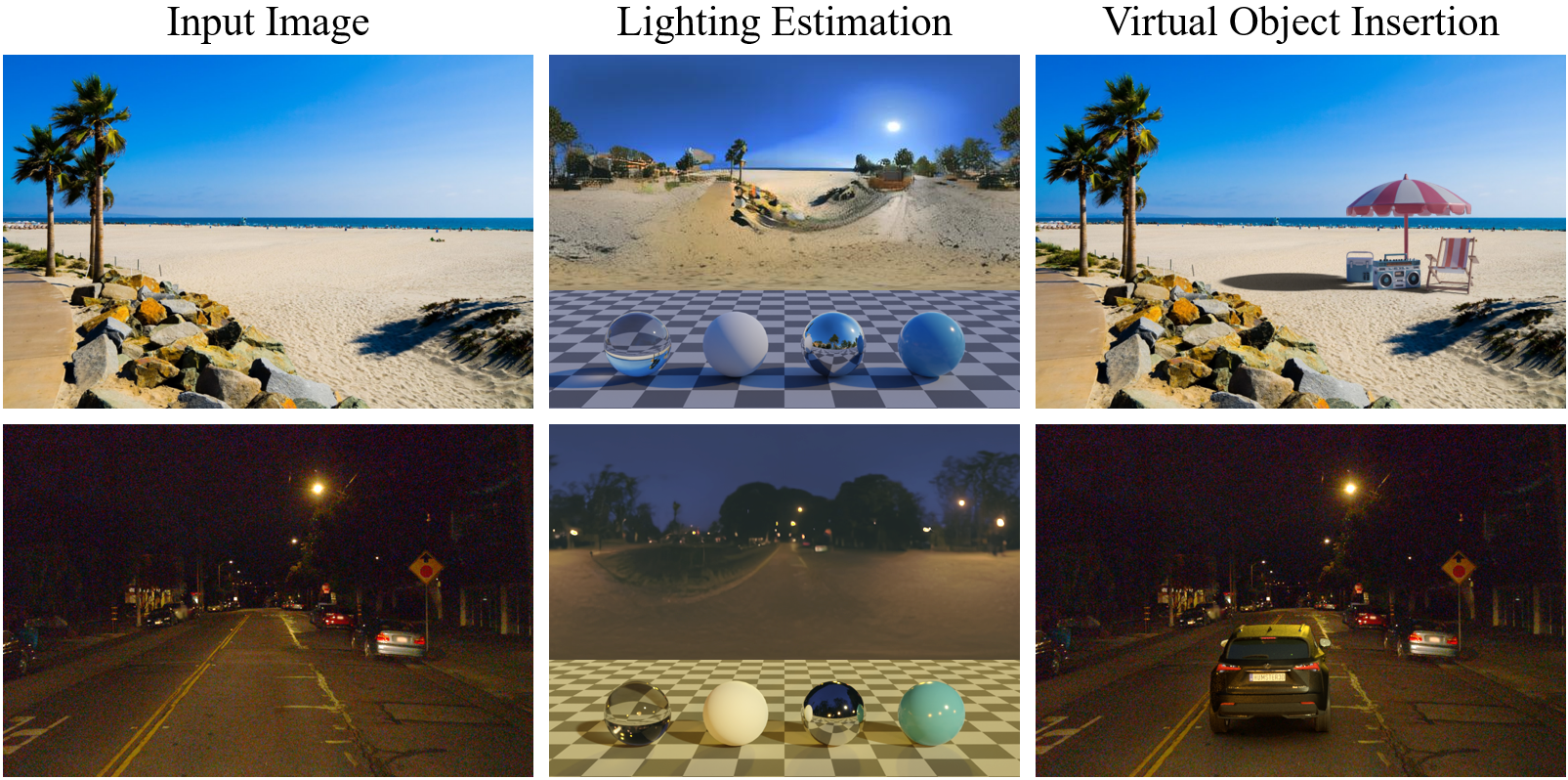
LuxDiT is a generative lighting estimation model that predicts high-quality HDR environment maps from visual input. It produces accurate lighting while preserving scene semantics, enabling realistic virtual object insertion under diverse lighting conditions. This model is ready for non-commercial use.
Use case: LuxDiT supports studies and prototyping in video lighting estimation. This release is an open-source implementation of our research paper, intended for AI research, development, and benchmarking for lighting estimation research.
[batch_size, num_frames, height, width, 3]; recommended resolution 480×720.exr HDR envmapsFrom the LuxDiT repository root:
python download_weights.py --repo_id <HF_ORG>/luxdit_base
This saves the checkpoint to checkpoints/luxdit_base by default. Use --local_dir to override.
DIT_PATH=checkpoints/luxdit_base
INPUT_DIR=examples/input_demo/synthetic_images
OUTPUT_DIR=test_output/synthetic_images

python inference_luxdit.py \
    --config configs/luxdit_base.yaml \
    --transformer_path $DIT_PATH \
    --input_dir $INPUT_DIR \
    --output_dir $OUTPUT_DIR \
    --resolution 480 720 \
    --guidance_scale 2.5 \
    --num_inference_steps 50 \
    --seed 33

python hdr_merger.py \
    --model_path checkpoints/hdr_merge_mlp \
    --input_dir $OUTPUT_DIR/ldr_log \
    --output_dir $OUTPUT_DIR/hdr
Use the LoRA adapter in this checkpoint for better generalization to real photos:
DIT_PATH=checkpoints/luxdit_base
LORA_PATH=checkpoints/luxdit_base/lora
INPUT_DIR=examples/input_demo/scene_images
OUTPUT_DIR=test_output/scene_images

python inference_luxdit.py \
    --config configs/luxdit_base.yaml \
    --transformer_path $DIT_PATH \
    --lora_dir $LORA_PATH \
    --lora_scale 0.8 \
    --input_dir $INPUT_DIR \
    --output_dir $OUTPUT_DIR \
    --resolution 480 720 \
    --guidance_scale 2.5 \
    --num_inference_steps 50 \
    --seed 33

python hdr_merger.py \
    --input_dir $OUTPUT_DIR/ldr_log \
    --output_dir $OUTPUT_DIR/hdr
Adjust lora_scale (e.g. 0.0–1.0) to control how much the input scene is merged into the estimated envmap.
| Checkpoint | Description |
|---|---|
| luxdit_base (this model) | Image-finetuned, with LoRA for real scenes |
| luxdit_video | Video-finetuned, with LoRA for real scenes |
For video inputs and object scans, use luxdit_video instead.
The base model is trained on the SyntheticScenes dataset:
Testing and evaluation use held-out 10% splits of the same dataset.
The model outputs dual tonemapped environment maps (LDR and log); use the HDR merger to get .exr HDR envmaps. By default, the camera pose of the input image defines the world frame. See the main README for the exact layout of LDR/log vs merged HDR.
NVIDIA believes Trustworthy AI is a shared responsibility. When using this model in accordance with the terms of service, ensure it meets requirements for your use case and addresses potential misuse. You are responsible for having proper rights and permissions for all input image and video content; if content includes people, personal health information, or intellectual property, generated outputs will not blur or preserve proportions of subjects. Users are responsible for model inputs and outputs and for implementing appropriate guardrails and safety mechanisms before deployment. To report model quality, risk, security vulnerabilities, or other concerns, see NVIDIA AI Concerns.
NVIDIA OneWay Noncommercial License. See the LICENSE in the LuxDiT repository.
@article{liang2025luxdit,
  title={Luxdit: Lighting estimation with video diffusion transformer},
  author={Liang, Ruofan and He, Kai and Gojcic, Zan and Gilitschenski, Igor and Fidler, Sanja and Vijaykumar, Nandita and Wang, Zian},
  journal={arXiv preprint arXiv:2509.03680},
  year={2025}
}